Thursday, 14 November 2013

Miniatures - An Antique Books Guide


Miniatures are a stable and well-known market for many book collectors, dating back hundreds of year.
These tiny books can be on any topic and of any size but must be under 3 INCHES wide or 3 INCHES high.

Some of the most famous are made by Bryce and are truly tiny but also you can buy sets by famous authors including Shakespeare that are easily readable. The main period that these books comes from will be between late Victorian and into the mid 1900's, often being touted as 'Bijoux' editions and thus fashionable.
Miniatures are popular with dolls-house buyers but also make a unique and attractive section of any bookshelf.

Below are a selection of miniatures decreasing in size to show how the size of print can change. The 2p coin measures exactly one inch across (2.5cm).


Large Miniature (4 Inches X 2.5 inches)
Facts:
Title - The Two Shoemakers (In Six Parts)
Date - Circa 1850
No. Pages - 160
Extras - Many illustrations
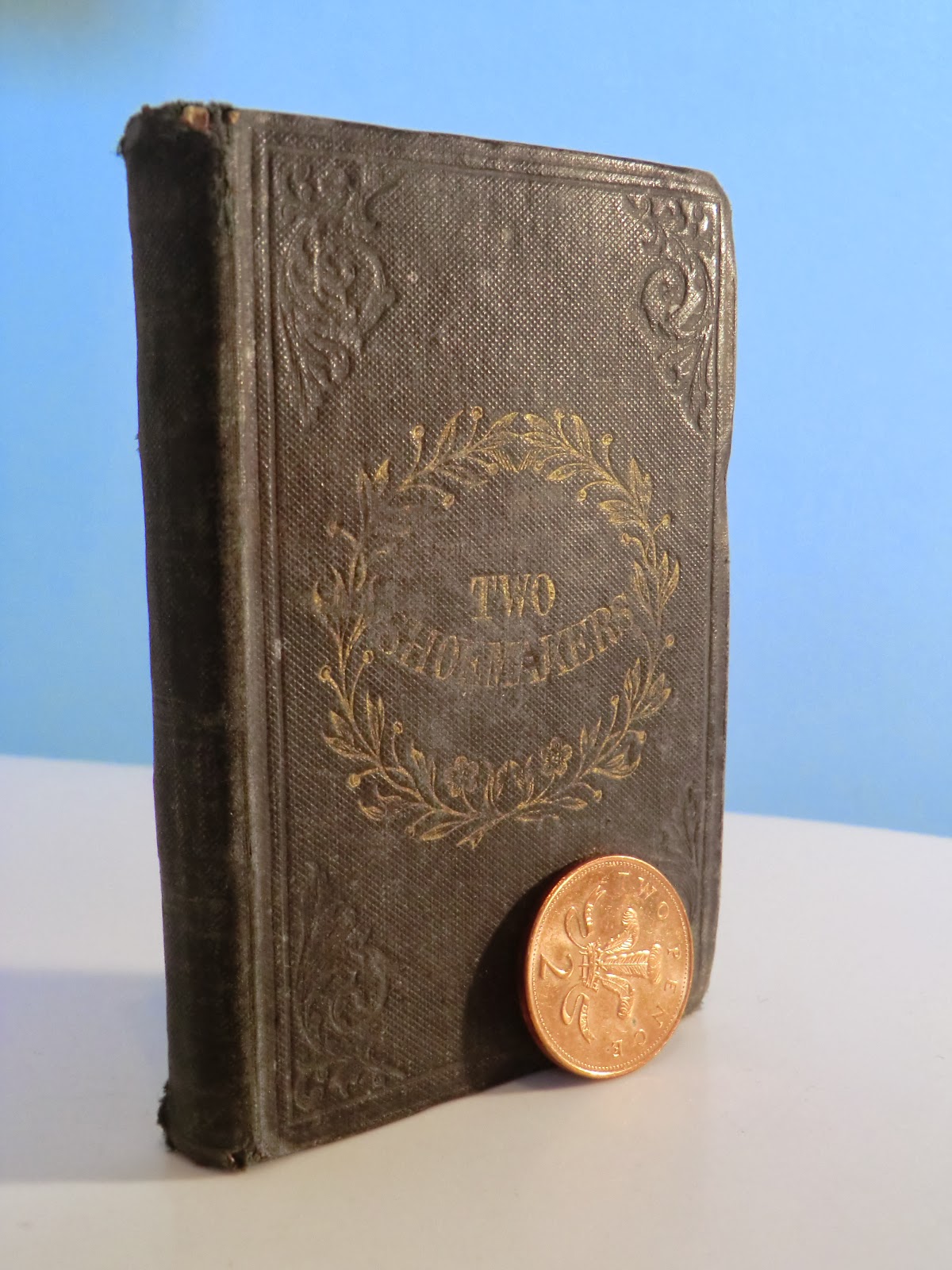


Large Miniature (3.5 Inches X 3 Inches)
Facts:
Title - Rays Of Light
Date - Circa 1890
No. Pages - N/A
Extras - Each page uniquely colour illustrated/ illuminated


Classic Miniature (2.75 Inches X 2.15 Inches
Facts:
Title - Coriolanus
Date - 1905
No. Pages - 425
Extras - Leather Bound + Gilt Edged


True Miniature (2.15 Inches X 1.8 
Inches)
Facts:
Title - The Imitation of Christ
Date - 1906
No. Pages - 570
Extras - Leather Bound, Gilt Edged and + Illustrated with Plates


Slim True Miniature (2.1 Inches X 1.4 Inches)
Facts: 
Title - Julius Caesar
Date - 1904
No. Pages - 340
Extras - Illustrated Frontis


Micro Miniature (1.1 Inches X 0.75 Inches)
Facts:
Title - Bryce's English Dictionary
Date - Circa 1890
No. Pages - 324
Extras - Micro book requiring magnifying glass to use


 So there we have it!
I hope that you have learned a little about Miniature books and maybe will consider investing in the future.
Thanks for reading and please share or comment if possible.


Sunday, 10 November 2013

Film and TV and Books - An Antique Books Guide


This post is simply to raise your attention to the power and value of a book influenced by Film or TV.
If you owned a copy of Cloud Atlas by David Mitchell in first edition form then three years back it may not have raised even £5. Yet when the 2012 film was released, first editions were selling for around the £200 mark - purely because the film had induced a sales hype.

This effect can been seen everywhere - in Harry Potter books, in Hobbits and Alice's. But this effect is not limited to TV. Famous series such as Game of Thrones have books that grew substantially in value after the franchises were launched on TV.

Always be on the look out for books of upcoming films.
Here's a list of a few on IMDB:
http://www.imdb.com/movies-coming-soon/

My advice would be to try and buy a copy of The Book Thief signed by the author - that one is almost certain to rise when the film is released next year.


Tuesday, 5 November 2013

An Antique Books Guide - How to estimate age Part 1


It is a useful skill to be able to guess the age of a book from it covers.
If you are searching for books (online or in shops) then to be able to estimated how old a book is just from the covers can save a lot of time and wasted energy.

This is the first part of a longer guide which will show you through the covers, the title page and other features how to estimate the age of a book with reasonable accuracy.

The covers are the most obvious way to tell a book's age and will be seen first.
Some can be tricky as they might not be conventional in style but generally they will follow patterns set by each era.
Below are a range of books from various eras with description for each - hopefully you will learn a bit more about the type of designs to look for in each age group.

Modern (1970+)

Modern books are usually identifiable for their clean, white pages but the covers too can tell us if a book is modern. This age group is most obvious as modern books are worlds apart from older ones.

Paperbacks will generally be clean and shiny, sometimes using gold foil to give a touch of style.
hardbacks will invariably have dust-jackets which will often be shiny.


Faux-Antique

Even during modern times publishers are still replicating antique style with books such as the famous Guild Publishing editions (one copy seen below).
An easy way to tell the age of such books is by looking at the page edges which will be far cleaner and neater than real antique books.


Vintage (1930-1970)

This era is quite broad and can be a little harder to guess accurately.
In this age group expect to see few hardcovers with decoration and many with plain covers that came originally with dust-jackets. If dust-jackets are still present they will often be in poor shape and made of flimsy, cheap paper.
Paperbacks will be thin and cheap.


Antique/ True Vintage 1900-1930

This is the era where books begin to get valuable, decorative and classified as antique.
Expect cases of high decoration, gilding to page edges and art-deco styling - look out for bold patterns and vertical lines used as decoration.
Some books can still be plain however, and thus difficult to discern from 1950's or later hardbacks.
Paperbacks are rare in this era and will almost certainly be in poor shape due to the weak binding.

Classic art-deco designs:


Some books will have plainer covers 


The pictorial plate to the front cover is common with this era


Some will begin to look close to late Victorian books in decorative style if they are sub 1910


 Victorian/ True Antique (1870-1900)

This era is where books become genuine antiques.
Despite this you can expect to see some of the boldest cover designs published.

Fine binding is popular in this era and looks very different to standard books due to the leather (or leather effect) binding and higher publication values:


The traditional designs of late Victorian books feature lots of gold, strong fonts and highly decorative covers


 Not all books of this era were decorative however and these can be hard to estimate in terms of age as they may look alike to 1930's or later hardbacks:


Early Victorian (1840-1860)

This era is quite unique as books are generally subtly decorated, without the elaborate embellishment of late Victorian books. Some will feature gilded designs but these will lack the colour and illustration of later publications.


Early antique 1800-1850

This era will start to show its age. Covers are often dark and un-decorated unless they are marbled in which case the same marbled effect will feature on the covers, page edges and front/ endpapers.
Leather binding features heavily in this era too.


 High Antique - Ancient (1800-)

 These books will almost always be bound in leather, calf or vellum and feature very little decoration.
Some books may be re-bound and so look newer than they are but the pages will give away the age.
Covers may be loose or detached and the overall impression of these era books will be of extreme age

Mid 1700's


 Early 1600's 


And that concludes Part 1 of the 'How to estimate the age of books' guide!
I hope it has been helpful or at least a little informative and please share, +1 or comment.