Wednesday, 21 May 2014

Ten Books You Must Own - Fiction (An Antique Books Guide)


Here is the first part in a series of guides to top ten books to collect.
Up first is the top ten for fiction. I have carefully selected a range of books that are best to read, to collect in terms of value and that offer the most versions for collectors to discover.


1. Alice in Wonderland - Lewis Carroll

This book is undoubtedly the king of the fiction bookshelf, or perhaps queen is more appropriate.

Alice in Wonderland may have been written close to 150 years ago but its grip over us hasn't waned one bit, with a blockbuster film released just a few years ago.
There are possibly hundreds of different editions of this book published and I have written an entire blog post on the top ten editions of this book alone:
http://anantiquebooksguide.blogspot.co.uk/2014/03/top-ten-alice-in-wonderland-most.html

For sheer enjoyment, ingenuity and variation, this book is number one. For the collector, this book offers numerous editions to own and is old enough to offer a truly 'antique' feel to your bookshelf.


2. The Hobbit - J.R.R Tolkien

Here is my personal favourite book ever written and a sure fire hit with any fiction collector. In fact, this book appears to people of all ages and has had enough editions printed to earn the number two spot on this list. First editions can reach up to £7,000 whilst more affordable versions that look similar to the original can be had to £30 whilst still maintaining the original charm of the first book.

With striking covers and an iconic dust-jacket in early editions, this book is not only a great read and a valuable asset but also a visually attractive book too.


3. Winnie The Pooh - A.A. Milne

Milne's most famous book has to be Winnie the Pooh and perhaps Great Britain's most famous book has to be Winnie the Pooh. Based around the Ashdown Forest in the South East of England, this book is a true classic thanks to its charming narrative that features themes of friendship, love and, of course, nostalgia.

A full set of the original Milne books (all four) looks most striking on the bookshelf as the book is quite small yet the monetary value and charm of this book ensures that it should be high on your list of fiction books to own.


4. Peter Pan - J.M Barrie

This is yet another famous Children's book and undoubtedly one of the best illustrated works of fiction, being illustrated originally by Arthur Rackham. The gilt cover decoration and lavish illustration make this book a joy to read but it also holds its value and even later editions illustrated by Arthur Rackham can reach £30, with a true first valued at £500 approx.


5. Harry Potter - J.K Rowling

This is the most modern book on this list yet a fiction bookshelf would not be complete without a copy. Rowling's first book and perhaps the most easy-going is the unassuming beginning of the world's highest-grossing film franchise. First editions still sell for £2,000 minimum and signed copies also reach high amounts. For a more grown-up look, try the Deluxe Edition which feature gilt edging and decorative cloth covers.


6. Fairy Tales - Hans Christian Andersen

No bookshelf should go without a copy of a fairy tales book, be it by the Brother's Grimm, Hans Christian Andersen or even Phillip Pullman.
Andersen's are the best known and have been published hundreds of times in a bewildering array of beautiful Victorian and Edwardian editions. Decorative covers are generally favoured for these books and will really stand out on your bookshelf. For sheer nostalgia, these innocent tales are great whilst the value of illustrated editions should not be sniffed at too, with Rackham's best selling for close to £1000.


7. 1984 - George Orwell

One of the most popular 'intelligent' books in modern fiction, nineteen eighty-four is the work that looked to the future and practically predicted CCTV and other technological advances. First editions can be obtained for between £100 and £150 and are great for a nourishing read. However, these editions feature plain covers that look basic on the bookshelf so I would recommend the leather styled anniversary edition printed in 1984.


8. The Water Babies - Charles Kinglsey

Another book that has been printed over and over again and illustrated by many of the top illustrators including, most notably, Harry Theaker. This charming story may seem a tad odd nowadays but is still great for a nostalgic book full of cheer. Plus, illustrated editions hold their value and look good on a bookshelf.


9. The Wind in the Willows - Kenneth Grahame

The famed tale of riverside cavorts enjoyed by a number of talking animals. Only a few editions have been printed of this, of which the Bransom illustrated edition is perhaps the most famous. This book is well-known by many and is yet another charming children's story that is fit for adult readers too. Early editions are valuable too.


10. Charlie and the Chocolate Factory - Roald Dahl

Possibly Dahl's best known book, this was one of his earliest and has been made into two blockbuster films and numerous adaptions including, recently, a West-End musical. Original editions are the only ones worth considering due to the impressive illustration and panoramic decorative covers. A great classic.


Thanks for reading - I hope you found this post interesting.


Please share or send a link to someone you know who may be interested - every view helps!

Sunday, 27 April 2014

A Plunge Into Space - Early Sci-Fi & Jules Verne (An Antique Books Guide)


Early Sci-Fi

Science Fiction has been around in various forms from the tenth century an more recently with Jonathan' Swift's 'Gulliver's Travels' and Mary Shelley's 'Frankenstein'.

However, true Sci-Fi, as we know it today, truly bloomed when developments such as electricity came about. Jules Verne is the most notable pioneer, with dozens of books focussing on Sci-Fi topics such as 'Twenty-Thousand Leagues Under the Sea' and 'From the Earth to the Moon'.

These works developed the public's general understanding of technology and considered what the future may hold. For example, in 'Twenty-Thousand Leagues Under the Sea', Verne writes about an electric submarine that uses electricity to protect itself and as a weapon. This is the kind of remarkable fore-sight that lead to Verne's popularity.


However, there is also a British writer who followed in Verne's footsteps and explore the topic of space travel specifically in an 1890 novel titled 'A Plunge Into Space'. This Victorian novel delved into space exploration, albeit of a rudimentary form and was in fact one of the first works of fiction that dealt largely with space.

Below are a few examples of this book from the fabulous covers to the foreword by Jules Verne and then the content itself.


Thanks for reading and as ever please share or comment if you can!


Saturday, 5 April 2014

Antique books and Christianity - The relationship (An Antique Books Guide)


Antique Books and Christianity


Christianity has played a huge role in book publishing - that much is fact.
The first example of a European book printed on a mass scale was the Gutenburg Bible whilst the later work of popular Christian publishers such as the British and Foreign Bible Society ensured that book printing became cheaper and more affordable.  

And even hundreds of years later, in the 1800's-1900's, Christianity still played a large role in book printing. This post aims to examine some of the more popular example of this, shown through real examples. I would like to apologize in advance for the vague and sporadic content of this article- I am by no means an expert on the topic.


From an early era

Many early books were published purely for their Christian values. Printing was originally seen to be a form of information dissemination that allowed Christians to spread the word of God to a larger audience.This meant that many early books were heavily Christian, with serious themes and topics.

This continued to the early 1900's, with many of the world's top selling books featuring heavily Christian themes. For example, A Tale of Two Cities featured Christian elements (R.E Resurrection) and has sold over 200 million copies, Steps to Christ has sold 60 million and In His Steps: What Would Jesus Do has sold over 30 million copies.

In fact, it would often be difficult to procure a publishing contract without Christian influence in the narrative. Hence many late Victorian and even Edwardian novels feature Christian elements.


Christian Buildings in illustrations

Illustration was rare and often counted as a luxury in books post 1800 so when these were included they had to be important and reflect an important image for the erader to enjoy. Great time was spent of these drawings and prints and many early books feature Christian buildings such as Cathedrals as these important plates.


The Pilgrim's Progress

This book is estimated to be one of the biggest selling in the world, having never been out of publication since it was first published in 1678. Hundreds of editions have since been published and numerous famous authors including C.S Lewis and Enid Blyton have referenced this book in their own works.
This is one of the most popular books in the world and also happens to be a religious tale - a fact that definitely played an important role in its rise to popularity.


The RTS (Religious Tract Society)

This famed publishing company was formed in 1799 and still runs today under a different name.

This company aimed to bring Christian texts and stories with a Christian influence to market for the poor and working class and published a huge range of books. These range from directly religious texts to stories with a Christian influence or underlying message.


Magazines

Magazines were popular in the late 1800's and early 1900's, often printed as large, well-bound volume compilations.
One of the most famous was The Strand Magazine which grew famous for Sir Arthur Concan Doyle's Sherlock Holmes stories. However, these books also features stories and articles relating to Christianity which has been recorded as aiding the success of this publication.


Magazines like The Sunday Magazine and the Leisure Hour often embraced these Christian idylls in the hope that children might be taught the world of God from a young age.
These books were lavished great quality publishing upon them, featuring engravings of cathedrals and even coloured plates in some cases.


Magic and Mysticism

A popular topic arose in contrast to Christianity - that of Magic and the Occult. These type of books are increasingly valuable for their bold and controversial themes and were often published in very small numbers due to the lack of popularity in contrast to the wildly circulated Christian texts.


Modern Day

Even modern day books can garner a wide audience if the theme relates to Christianity.
For example, the hugely popular Da Vinci Code has sold in excess of 80 million copies and features Christian elements, even if on a somewhat different side to Victorian novels. Even teen books such as The Hunger Games can be related to Christian themes such as self-sacrifice and hope.


Final Word

Whilst some predict the demise of the book and note the weakening of Christianity, what is clear is that the two forms together have an important role in assisting each other to popularity.
Whilst the revolutionary power of Christian book publishers has dwindled, Christianity can still be witnessed in modern day books and has an important part to play in antique boo collecting and publishing heritage.

Thanks for reading and please share/ comment if this post interested you.


* Please note that the image of The Da Vinci Code is a stock image - all of the other photographs are my own.


Sunday, 30 March 2014

Miniatures - An Antique Books Guide (Mother's Day Special)


Miniatures are a stable and well-known market for many book collectors, dating back hundreds of year. They are also adorable, unique and great as gifts.
These tiny books can be on any topic and of any size but must be under 3 INCHES wide or 3 INCHES high to qualify as a true miniature.

Some of the most famous are made by Bryce and are truly tiny but also you can buy sets by famous authors including Shakespeare that are easily readable. The main period that these books comes from will be between late Victorian and into the mid 1900's, often being touted as 'Bijoux' editions and thus fashionable.

Miniatures are popular with dolls-house buyers but also make a unique and attractive section of any bookshelf. If you need a gift for someone and can't think what then a miniature book could be the gift for you.

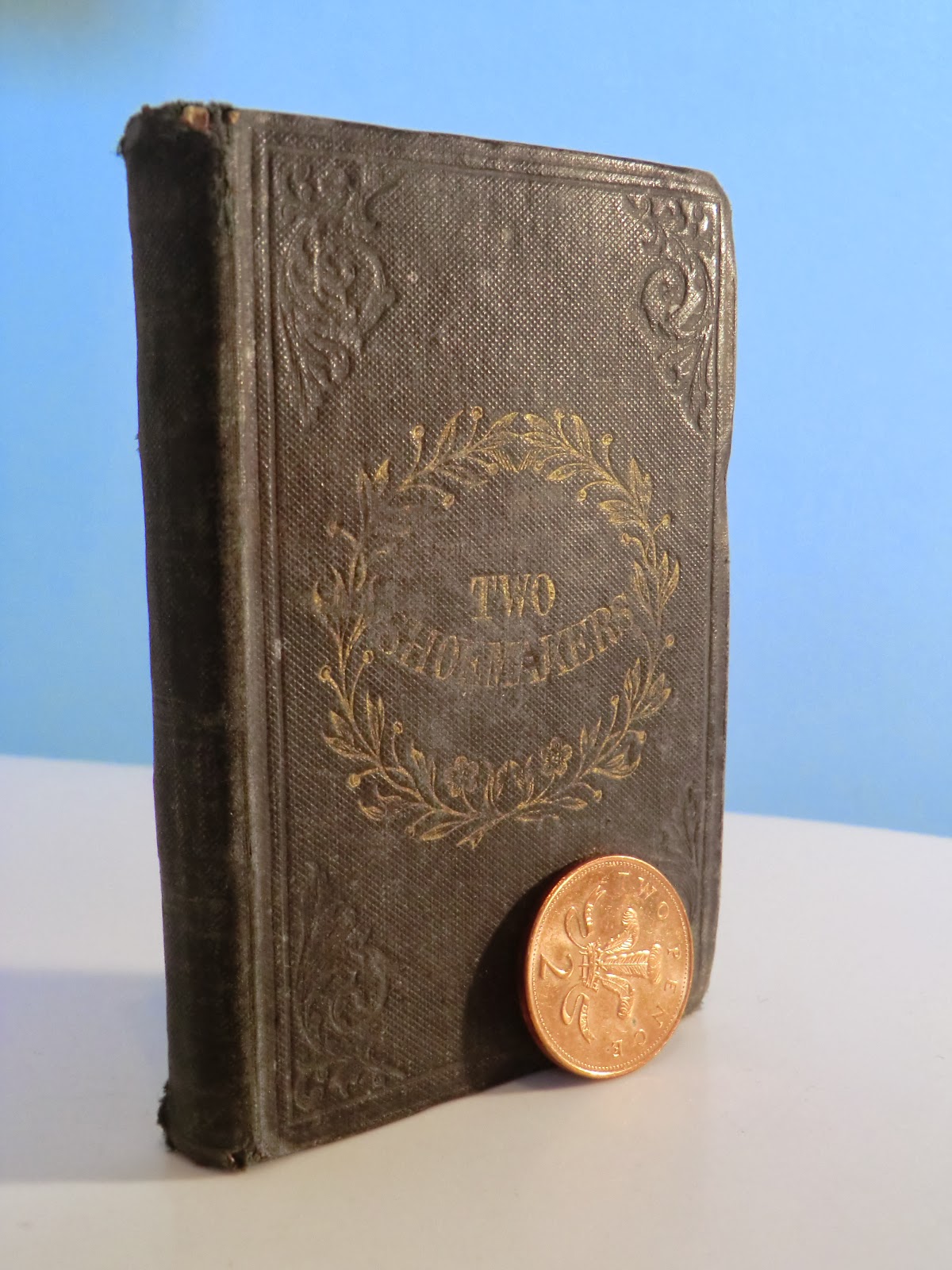
Below are a selection of miniatures decreasing in size to show how the size of print can change. The 2p coin measures exactly one inch across (2.5cm).


Large Miniature (4 Inches X 2.5 inches)
Facts:
Title - The Two Shoemakers (In Six Parts)
Date - Circa 1850
No. Pages - 160
Extras - Many illustrations


Large Miniature (3.5 Inches X 3 Inches)
Facts:
Title - Rays Of Light
Date - Circa 1890
No. Pages - N/A
Extras - Each page uniquely colour illustrated/ illuminated


Classic Miniature (2.75 Inches X 2.15 Inches
Facts:
Title - Coriolanus
Date - 1905
No. Pages - 425
Extras - Leather Bound + Gilt Edged


True Miniature (2.15 Inches X 1.8 
Inches)
Facts:
Title - The Imitation of Christ
Date - 1906
No. Pages - 570
Extras - Leather Bound, Gilt Edged and + Illustrated with Plates


Slim True Miniature (2.1 Inches X 1.4 Inches)
Facts: 
Title - Julius Caesar
Date - 1904
No. Pages - 340
Extras - Illustrated Frontis


Micro Miniature (1.1 Inches X 0.75 Inches)
Facts:
Title - Bryce's English Dictionary
Date - Circa 1890
No. Pages - 324
Extras - Micro book requiring magnifying glass to use


 So there we have it!
I hope that you have learned a little about Miniature books and maybe will consider investing in the future.
Thanks for reading and please share or comment if possible.