Here is a guide that I have created from personal experience of many different aspects of book collecting that can be useful to know.
Ranging from signed copies to Fine Binding, this guide aims to help you start or add to your book collection or even just book knowledge.
I am by no means an expert but I have learned a little throughout the years and I have attempted to put that specific knowledge into this blog.
* For the problems and flaws of antique books please see the below post *
http://anantiquebooksguide.blogspot.co.uk/2013/08/antique-book-problems-and-flaws-guide.html
BOOK DEFINITIONS:
Antique pertains to books dating over 100 years old whilst vintage can be considered anything printed between 1930 and 1960
Retro could be considered anything later than 1960 to an extent. Please note that all of these are just loose bands.
Each age group holds some very rare books - not just antique books are collectable and sought after!
Modern first editions are something of a marvel with some of the most collected such as Harry Potter and the Philosopher's Stone selling for late hundreds up to thousands.
Here begins a definition of different book types, features and designs:.
Art Deco Book Cover
Here is an Art Deco cover - a classic William Morris style design. These designs are often floral and always striking with bright colours in bold design.
1910's Period Book Cover
Most likely a highly decorative form of Art Deco design, books like the copy below are highly collectible for the beauty of the design itself
Vintage Book Cover
Here is an Enid Blyton first edition from the 1950's and a classic vintage book
Fine Binding
Here is a classic example of a finely bound book.
Often with leather, calf or vellum edges and marbled covers, these books were expensive to produce, to buy and are to collect.
They are also often strongly bound even now and are the staple of Dark wood or classic libraries the world over
The Late Victorian Decorative cover
Here is a fine example of the late Victorian book cover.
With exquisite detailing and unique font giving a window into the book, these covers can be captivating and striking such as the example below.
Modern Gilt / Deluxe Cover
Here is a modern cover from the iconic Guild Publishing house. With an intricate gilt design and a faux leather effect cover this book appears to be far older than the 1970's publication it is
Art Nouveau Cover Book
Here is a classic art nouveau style cover, featured on the collectible Chiswick Shakespeare series printed between the late 1890's and the early 1900's
Front/ Rear Papers (FFEP's)
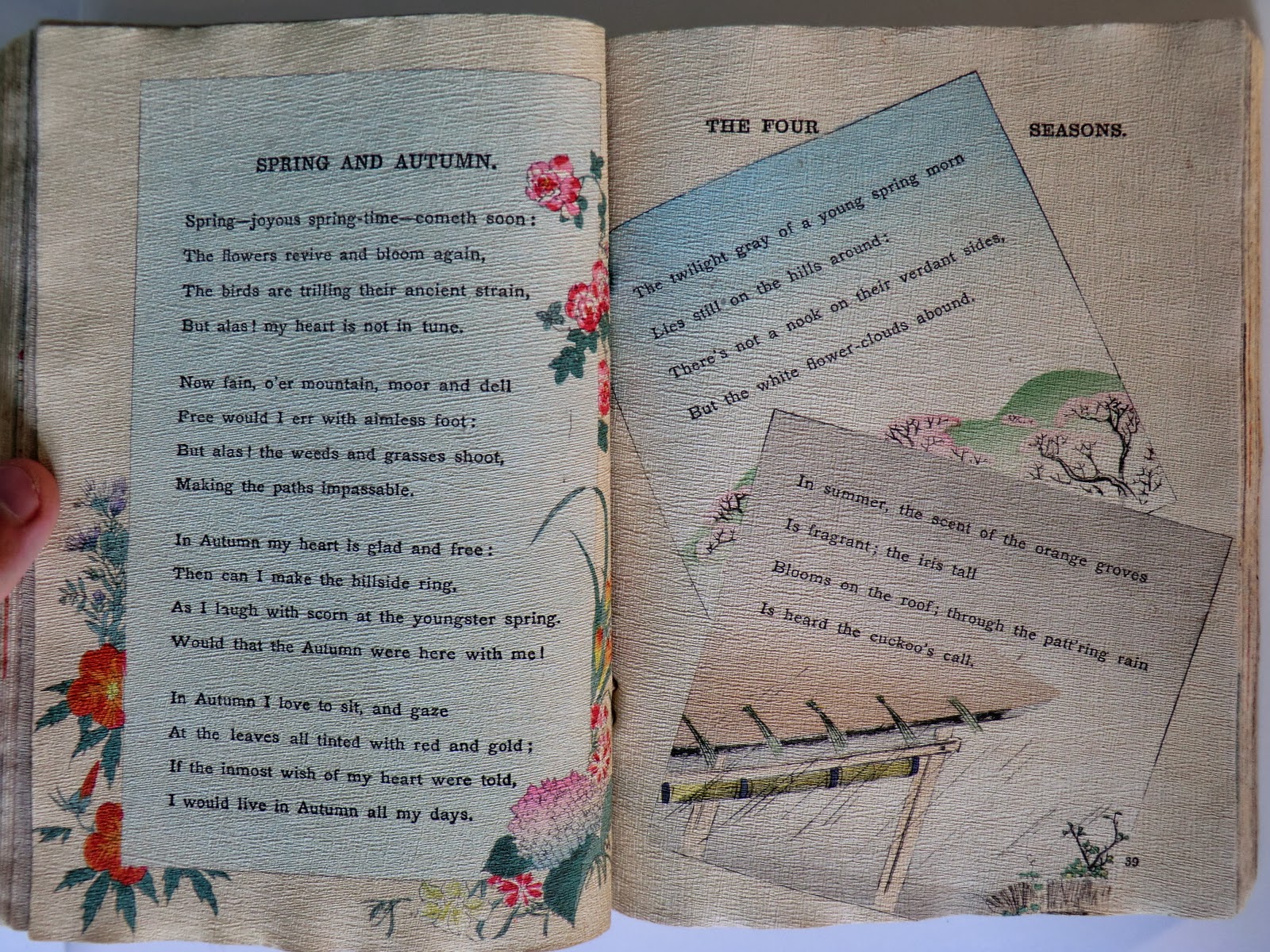
Virtually every hardback book has a front and rear paper before the main text. Some are plain, others more decorated with a repetitive pattern such as many late Victorian publications, and others unique such as the classic Hobbit map.
Frontispiece
After the cover and the front paper comes the frontispiece.
Not all books have them but a good number of antique and vintage books do. Often in older books these are black and white illustrations but in rarer or more recent publications these can be in colour and really add to the presentation of a title
The First Edition Print Line
The first edition is something that any collector wants. Be it an antique book or a modern one, a first edition is a nearly surefire way to add value to the book.
Ending in a one, the number line can read differently on some books.
Older titles were only really given one publication or printing so first editions for some antique texts were rather easy to come by. Similarly modern first editions are a certain best seller so popular books such as the later Harry Potter books were given a large print run in first edition form meaning values for these are low.
The Dust Jacket
A dust jacket is and was a popular way to protect books. Many antique book after the 1900's were issued with such covers even when the covers were bold and decorative, purely to protect such designs.
Books of an age still with such dust jackets can double in value
Folio Society and the Slipcase
Firstly, some books comes with a dust jacket as seen above whilst others come with slipcases. These are often more recent and valuable or collected texts.
Secondly, the Folio Society is synonymous with quality, being a publishers that reprints a great range of world famous texts
Gilt edging or Gilding
Back to the externals of a book.
Gilt edging or gilding is reasonably common on more expensive books of the past with great popularity found in the late Victorian period. To have a book gilded nowadays to such quality can cost hundreds of pounds.
Most antique books have a single edge that has been gilded - often the top. Some nicer books can have tripled gilding which means every visible edge is covered with the shiny gold dusting
Disbound
Below is an example of a book that is no longer bound.
This text is complete and almost as it was printed except for the fact that the binding - most likely glue - has loosened or weakened completely resulting in the text block being completely separate from the covers.
A reparation is needed but this can cost a lot of money so in most cases, such a book is best kept as a 'reading copy' i.e not to sell or collect!
A tipped colour plate (Dulac etc)
Plates are pages with illustrations, maps etc featured throughout some antique books.
Often these are illustrations and can add value to a book.
For example the illustration below is a colour plate painted by Edmund Dulac and is collectible by itself with some collectors separating and framing such images.
Look out for Arthur Rackham, Harry Rountree, Heath Robinson and Mable Lucy Atwell for collectible illustrators.
Colour Plates
Colour plates are unique to each artist and also rare in pre 1890's books. In earlier cases such as early 1800's and prior, books with colour illustrations can fetch handsome sums purely due to the colour plates.
Wood Engraving
Another type of illustration is the wood engraving.
Often more basic, more popular and more frequent, these illustrations can be found in many antique books.
Steel Engraving
The steel engraving is a more intricate, advanced form of illustrations often requiring thicker, stronger paper or card to print upon.
These are rarer than wood engravings, often full page and more valuable.
Only copy available
By searching through book selling websites you can find out whether your book is common or rare and thus valuable.
In some cases there will not be any copies of your book for sale and this is something you can capitalize on if you choose to sell.
Vintage paperback
Some classic books can be found as a vintage paperback. Generally Penguin Books published these but there are other publishers too.
Look out for famous authors or books such as 'The ABC Murders'
The copy below sold for £20 despite the fact that the spine was coming away from the inside a little.
Illuminated
An illuminated book features a page or several pages of highly decorative writing, usually with gold/ gilt colouring.
These books are often valuable purely for the artistic value.
Signed
The power of a signed book is quite impressive.
If you have a letter from an author or purely a signed copy then expect the value to rise far above the value of standard editions.
Collections/ Sets
A set or collection can be a valuable asset.
If you have a complete set, especially in early/ first editions then your books will be worth a lot. It is generally wise to keep such sets together to increase the value as collectors often look for complete collections as opposed to buying and searching for individual copies which can be time consuming and cost ineffective.
Leather/ Tooled Leather
If you have a leather bound copy of a book then it can be worth more than other copies in some cases. These are generally nicer editions.
The first of a set
The book below is the first Guinness World Record book to be published and is as such the most valuable in the series.
Look our for early or first in series such as The Philosopher's Stone in the Harry Potter franchise.
The book below is worth approximately £25
Famous for another book
If the author is famous for writing a certain book, early editions of their other books can still be valuable.
Take for example 'Rhyme? And Reason?' by Lewis Carroll.
Miniatures
A miniature book is quite a novelty and in some cases can be extremely collectible.
The smaller the better here although the book must have real pages to be worth much at all.
Bryce's Dictionary is one to look out for, being the smallest in the world.
Excessively Old
Books dating pre 1700 are almost always going to be worth at least £20 just for their age.
If they are in English then the base value is higher too.
That concludes this lengthy guide!
I hope that if you made it this far the post helped you in some way.
Please bear in mind that value can be subjective but the values or advice I have given has worked for me.
If you have any questions or need advice please contact me at vaugc002@gmail.com or feel free to comment, +1 or share.
Thanks for reading!




cE9s4PsNGPBSBmC7!ERw~~60_12.JPG)


